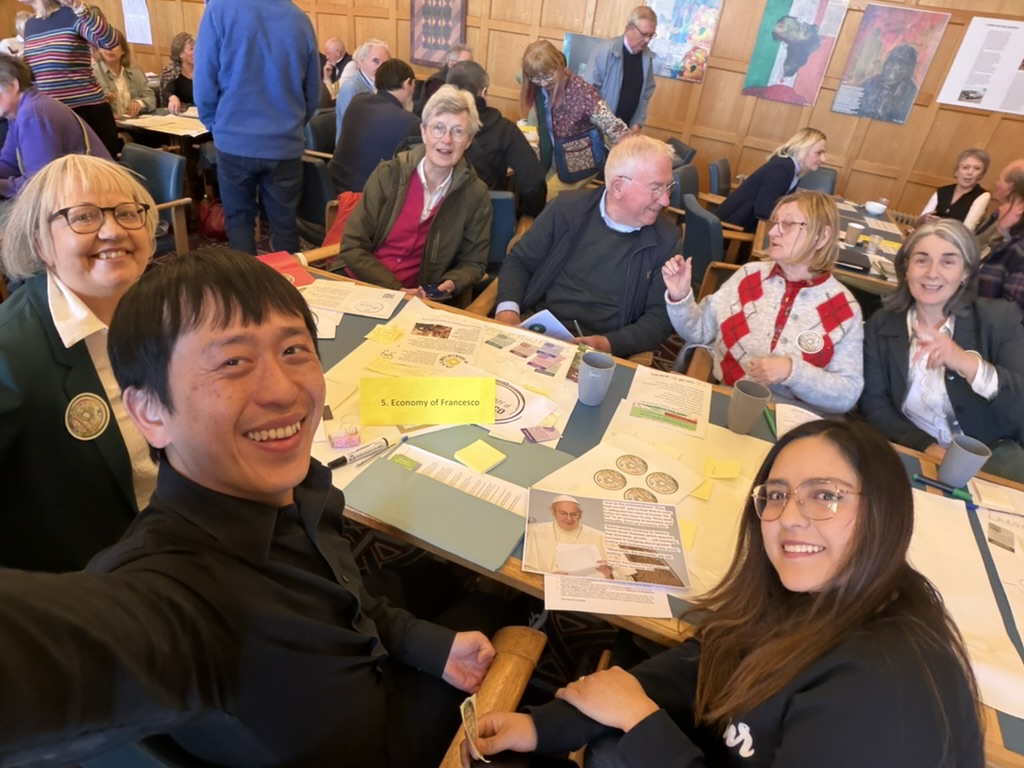
On Earth Day 2026, I attended the “An Economy of Enough” conference at Queen’s University Belfast organised by Join the Dots Together, a network dedicated to climate justice in Northern Ireland. Held as part of the university’s annual Reach’26 Arts and Sustainability Festival, the event brought together about eighty people, from academics and government officials to faith communities and sustainability professionals, to work through three 20-minute “World Café” rounds designed to help us brainstorm and share ideas.
My role was to host a World Café table for the Economy of Francesco UK Hub, alongside nine other topics, ranging from Doughnut Economics to the Wellbeing Economy Alliance.
I started with a quick overview of how the Economy of Francesco movement began with Pope Francis’s 2019 invitation, through to the global encounters in Assisi 2022 and Rome 2025. Then, I invited everyone to take part in an activity I’d adapted from the Marketplace of the Common Good workshop at last year’s event.
The aims of the World Café rounds was to find ways to build a sustainable economy where people and the planet can thrive without hurting future generations. We looked at the opportunities ahead, the barriers in our way, and the large and small actions we can take.
In our first round, the group chose to focus on “youth and future generations” alongside “older people and intergenerational voices”. I added a twist: instead of just looking for opportunities for these groups, I asked the participants to consider how we can tap into the skills and wisdom of these groups already have to rebuild our economic system.
Our World Café participants found that there’s a huge opportunity in matching the strengths of different generations. There’s a clear call to take the energy young people have for the climate and turn it into real action, especially by moving education away from a utilitarian approach to securing future work to an approach where learning is truly “for life”. At the same time, older generations offer invaluable experience in health, wellbeing, and political advocacy.
Next, we talked about the barriers. Deep-rooted issues like inequality and poverty make it hard for many people to get involved in the first place. We also noted that rigid political systems and a lack of public “third spaces” can hold back the creativity of young people. There’s also a serious concern about how we’ll fund essential services when our current economic system prioritises extractive consumption over care and wellbeing.
To wrap up, we all agreed we need more “spaces for encounter”—places where different generations can share their stories and build hope. On a larger scale, the priority is to use our collective creativity to redesign the economy for the common good, including the idea of lowering the voting age to 16. On a smaller scale, we’re focusing on immediate collaboration between charities and schools to make sure community voices are heard. Together, these steps help us map out an “economy of enough” that trades “an economy that kills” for an economy of life.
Afterwards, we heard from Dr Lorna Gold, the Executive Director of the Laudato Si’ Movement, who inspired us with practical examples where people are already addressing our global environmental and social polycrisis by replacing our “more is better” mindset in our economic systems with one that prioritises “living well with enough” within the Earth’s planetary limits.

